
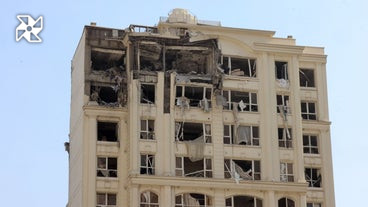
Trump Faces Major Foreign Policy Crisis: Israel's Iran Strikes Threaten Middle East War. Israel's attacks on high-profile Iranian targets escalate tensions, forcing President Trump to decide whether to intervene and prevent a devastating Middle East conflict that could endanger millions, involve US forces, and worsen the global economy. The ongoing crisis, fueled by Trump's trade policies and regional instability, demands immediate diplomatic action
Israel's multi-day air assault on Iran targets over 100 sites, including Tehran, killing military commanders, nuclear scientists, and civilians. This escalating conflict, potentially lasting up to two weeks, presents President Trump with a major foreign policy crisis, risking a wider Middle East war and global economic instability. Israeli officials cite Iran's nuclear ambitions as justification, while Iran denies any imminent attack or nuclear weapons program. Trump's call for diplomacy faces challenges amidst the administration's limited resources and ongoing tensions
Israel's preemptive strikes on Iran, targeting key military and nuclear sites, escalate Middle East tensions. While Israeli officials cite Iran's advancing nuclear program as justification, Tehran denies any intention to build a nuclear weapon and there's no evidence of an imminent attack. This major foreign policy crisis for President Trump necessitates a critical decision on potential US involvement and the risk of wider conflict
Iran Nuclear Deal Negotiations: Amidst escalating tensions and Israeli strikes, the US and Iran have engaged in months-long discussions regarding a potential agreement to curb Iran's nuclear program in exchange for sanctions relief
On Friday morning, Trump appeared to call for diplomacy on his social media platform Truth Social: “There is still time to make this slaughter, with the next already planned attacks being even more brutal, come to an end. Iran must make a deal, before there is nothing left.”
Trump's Iran Crisis: A Weakened Administration Faces a Foreign Policy Test. The President's unpredictable leadership, coupled with a depleted National Security Council, hollowed-out State Department, and Pentagon staffing shortages, severely hamper the administration's ability to respond effectively to escalating tensions with Iran. Mass firings of diplomats and empty top positions further exacerbate the crisis, raising concerns about the US's capacity to navigate this critical foreign policy challenge
Trump Faces Middle East Crisis: Will He Defy Netanyahu on Iran? Key administration officials, including White House Chief of Staff Susie Wiles and Vice President JD Vance, have voiced concerns about escalating conflict with Iran, contrasting with hawkish figures like former National Security Advisor Mike Waltz. President Trump now faces a critical decision: intervene to prevent a wider Middle East war, potentially defying Israeli Prime Minister Benjamin Netanyahu's actions – a move urged by some conservatives, including Tucker Carlson – or risk a devastating regional conflict. The situation follows significant Israeli airstrikes on Iranian targets
Amid escalating tensions in the Middle East, Stand Together's VP of foreign policy, Reid Smith, highlights the clear division over Israel's preemptive strikes on Iran. This significant foreign policy crisis for President Trump demands a crucial decision: intervene to prevent a wider Middle Eastern conflict or risk global destabilization
Israel's supporters must proceed cautiously. The current conflict risks jeopardizing broad, bipartisan US support for Israel, potentially shifting even conservative backing. This escalating crisis demands careful consideration of the potential consequences
Trump's consistent push for a nuclear deal with Iran faces staunch opposition from Israeli Prime Minister Netanyahu and influential US hawks. These critics, including prominent Republican lawmakers, argue that Iran's untrustworthiness necessitates a complete ban on uranium enrichment—a condition Tehran rejects. They contend that military force is the only viable option to curtail Iran's nuclear ambitions and compel concessions, creating a significant foreign policy challenge for President Trump amidst escalating Middle East tensions
Post-Obama Iran Nuclear Deal: Increased Iranian Nuclear Capabilities & Current Middle East Crisis
US-Israel Relations at a Tipping Point: Trump Faces Iran Crisis. With Israel launching major strikes on Iran, President Trump faces a critical decision on escalating Middle East tensions. As Israel's key military ally and sanctions enforcer, the US is deeply involved. Trump is consulting national security officials and Israeli Prime Minister Netanyahu to determine the next steps in this unfolding crisis, which threatens wider conflict and global economic instability
Iran's potential retaliation against recent Israeli strikes on Iranian targets creates a volatile Middle East crisis for President Trump. The risk of escalating conflict, involving thousands of US troops and potentially prompting further Israeli action, demands an urgent decision. Iran's drone attacks on Israel, coupled with the US evacuation of some regional personnel, highlight the growing tension and the potential for a wider war impacting global stability and the economy. Trump's call for diplomacy faces challenges given the administration's limited resources and unpredictable approach to foreign policy
Israel's preemptive strikes on Iranian military sites and key figures, coordinated with the U.S., spark a major foreign policy crisis for President Trump. The attacks, reportedly targeting nuclear scientists and military commanders, raise the stakes in the ongoing Iran nuclear threat and fuel debate over potential regime change. Hardliners are aligning with Trump's calls for diplomacy amidst escalating tensions and the threat of wider Middle East conflict
Trump faces a critical Middle East crisis as escalating Israeli strikes on Iran threaten all-out war. Deep divisions within Trump's foreign policy team, coupled with conflicting goals between the US and Israel, hinder de-escalation efforts and complicate the path to a diplomatic solution. The administration's limited resources and internal conflicts jeopardize a peaceful resolution to this volatile situation
Trump has, for years, claimed he will limit global conflict, promising “peace through strength” and accusing his political rivals of enabling bloodshed in contexts like Ukraine and Gaza, while questioning deployments of American troops abroad. That political brand seemed reflected in the State Department’s Thursday night statement about the Israeli attack, which emphasized that it was “unilateral” and urged Iran not to “target U.S. interests or personnel.”
On Friday, the president told CNN “hard-liners” in Tehran had been killed, boosting chances for diplomacy. And Tom Barrack, the U.S. ambassador in Turkey and one of the personal friends Trump is relying on as a top Middle East deal-maker, posted on X: “Even in tension, there’s always a moment for dialogue to weave peace.”
Barrack and Steve Witkoff, another business figure who is leading the U.S.–Iran negotiations for Trump, are seen as more pragmatic than many in the traditional GOP national security establishment — and their influence has grown as Trump has repeatedly fired officials whom members of his MAGA movement say are too bellicose and tied to the so-called “deep state.”
“Trump has, for years, claimed he will limit global conflict, promising ‘peace through strength’ and accusing his political rivals of enabling bloodshed in contexts like Ukraine and Gaza.”
But Netanyahu and influential hawks are openly speaking of increasing pressure on Iran, not of compromise.
The Israeli leader appears to be betting that, as he did under President Joe Biden, he can treat the U.S. as primarily an enabler of his goals through military support, reacting to Israeli moves rather than being the force driving events.
Netanyahu has been able to do that with his ongoing, devastating U.S.-backed offensive in the Gaza Strip, pummeling Palestinians and avoiding a settlement with the Gaza-based militant group Hamas even as Trump has repeatedly expressed frustration. Under the Biden administration, Israel was able to use continued claims of interest in diplomacy and dramatic PR-focused moments — like its deadly pager attack in Lebanon — to sustain U.S. backing and defuse criticism as it pursued sweeping military campaigns.
Now, George Washington University professor Marc Lynch wrote on Friday, “Israel’s attack on Iran is best understood neither as pre-emptive nor preventive, but as a continuation of its attempt to remake the Middle East through force.”
“The pattern of attacks in the first day of Israeli strikes actually suggests that the target of the attack is the regime itself, not necessarily the nuclear program,” Lynch continued.
It’s unclear if Netanyahu’s playbook will work under Trump and against a far more capable opponent than Hamas or Hezbollah. As Iran faces greater pain and reputational damage, it could deploy a wide range of tactics, across the Middle East or even globally, to push back against Israel and the U.S. as its patron. That could create painful, unexpected consequences and a mounting, deadly, tit-for-tat cycle of violence.
Some observers claim a military-focused approach is the way to achieve Trump’s stated goal of preventing a nuclear Iran. “Israel should be hailed by nonproliferation organizations,” Jonathan Conricus, a former spokesperson for the Israel Defense Forces who now works at the hawkish Foundation for Defense of Democracies think tank in Washington, wrote on X.
Yet experts have, for years, said force alone cannot destroy Iran’s expertise in nuclear technology, and could instead spur its leaders to see developing weapons as the only way to protect their rule.
For two decades, HuffPost has been fearless, unflinching, and relentless in pursuit of the truth. to keep us around for the next 20 — we can’t do this without you.
We remain committed to providing you with the unflinching, fact-based journalism everyone deserves.
Thank you again for your support along the way. We’re truly grateful for readers like you! Your initial support helped get us here and bolstered our newsroom, which kept us strong during uncertain times. Now as we continue, we need your help more than ever. .
We remain committed to providing you with the unflinching, fact-based journalism everyone deserves.
Thank you again for your support along the way. We’re truly grateful for readers like you! Your initial support helped get us here and bolstered our newsroom, which kept us strong during uncertain times. Now as we continue, we need your help more than ever. .
Already contributed? Log in to hide these messages.
For two decades, HuffPost has been fearless, unflinching, and relentless in pursuit of the truth. to keep us around for the next 20 — we can’t do this without you.
Already contributed? Log in to hide these messages.
“If the Trump administration truly wants to avoid Iran’s path to a bomb, it should clarify its involvement in these strikes and work to strike a deal. This will be exponentially more difficult if strikes continue,” Nicole Grajewski, a fellow at the Carnegie Endowment for International Peace think tank, wrote on Bluesky.
Source: Original Article