
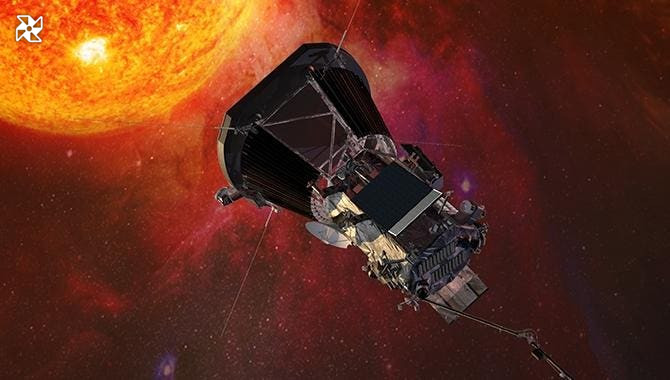
Parker Solar Probe Makes Final Record-Breaking Close Approach to the Sun: NASA's Heat-Shield Technology Triumphs
NASA's Parker Solar Probe completed its third and final closest-ever approach to the Sun, reaching a mere 3.86 million miles (6.1 million kilometers) from the solar surface. This "hyper close" pass, following previous record-breaking perihelions on December 24, 2024, and March 22, 2025, marks a significant milestone in solar research, pushing the boundaries of heat-shield technology and unlocking crucial data about the Sun's corona
Parker Solar Probe Achieves Record-Breaking Sun Approach: The heat-shielded spacecraft made its third and final closest approach to the sun, reaching a mere 3.86 million miles (6.1 million kilometers) from the solar surface—a feat NASA calls "hyper close." This unprecedented proximity helps unlock the mysteries of the solar corona and solar wind
Parker launched on Aug. 12, 2018, and has since conducted 23 perihelions — close passes — of the sun, getting to within 3.86 million miles (6.1 million kilometers) twice before today’s repeat performnce.
For scale, that’s four yards from the end zone if the distance between Earth and the sun was the length of an American football field, according to mission scientists.
During this final perihelion of the mission, the probe will be traveling at around 430,000 miles per hour (690,000 kilometers per hour). According to NASA, that’s fast enough to get from Philadelphia to Washington, D.C., in a single second.
Perihelion 24 also sees it forced to withstand temperatures of 1,600 to 1,700 degrees Fahrenheit (870 to 930 degrees Celsius). Its only armor against both temperature and extreme ultraviolet radiation is a carbon composite shield.
Parker is in a highly elliptical orbit, which takes 88 days but allows it to occasionally swoop particularly close to the sun.
One of the main objectives of the mission is to understand why the sun’s corona, its outer atmosphere, is a million times hotter than the photosphere, its surface.
The corona is where the solar wind originates from, so solar physicists must understand it better if they are to forecast space weather more accurately. That’s important because the state of the solar wind — a stream of charged particles interacting with the Earth’s atmosphere — can damage satellites and harm astronauts, as well as cause Northern Lights.
The latter half of Parker’s mission has coincided with the peak of Solar Cycle 25, the current 11-year-long cycle of the sun, during which our star experiences a waxing and waning of magnetic activity.
A study published on June 3 used data from Parker while flying close to the sun, reveal a new source for energetic particles in the solar corona. The mechanism, called magnetic reconnection, heats the solar atmosphere, accelerating solar wind particles. Magnetic reconnection — when magnetic field lines converge, break apart and reconnect in an explosive physical process — is responsible for powerful solar events, such as solar flares and coronal mass ejections.
“We’ve seen how magnetic reconnection behaves near Earth, but Parker has now shown how potent it is near the sun, where magnetic fields are significantly stronger,” said Dr. Mihir Desai, lead author and a scientist at the Southwest Research Institute in San Antonio, Texas.
Parker isn’t going anywhere. Locked in the orbit of the sun, it will continue to loop around our star. However, it was gravity assists at Venus that gave the spacecraft enough momentum to get so close to the sun. No, it’s within the orbit of Venus, that opportunity is lost, so it won’t be able to reach any closer to the sun than it already has done.
According to Live Science, the spacecraft’s thrusters will eventually run out of fuel, and it will burn up, though its heat shield may remain in orbit for thousands of years.
Source: Original Article