
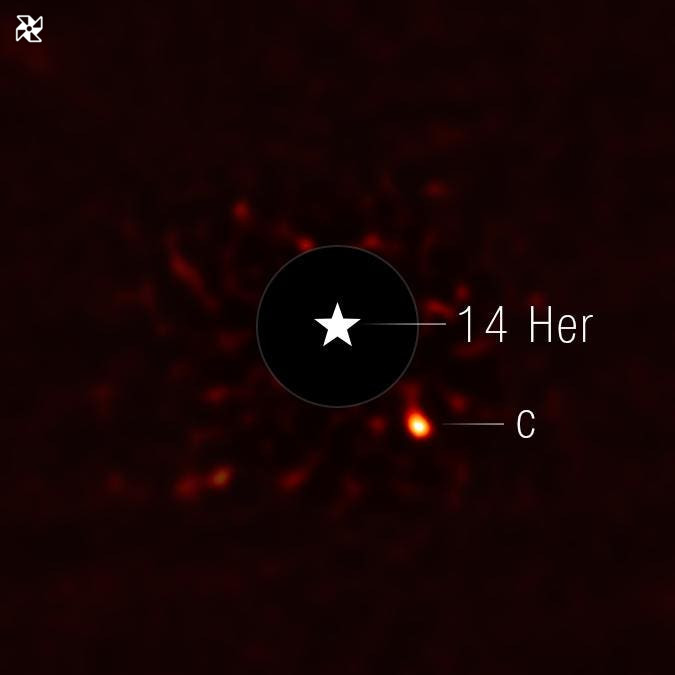
James Webb Telescope Captures First Direct Image of Cold Exoplanet 14 Herculis c: A groundbreaking image from NASA's James Webb Space Telescope reveals 14 Herculis c, a frigid exoplanet orbiting a star 60 light-years away. This giant, Jupiter-sized planet offers unprecedented insights into the evolution of planetary systems within the Milky Way galaxy
James Webb Space Telescope Captures First Direct Image of Cold Exoplanet 14 Herculis c. This groundbreaking NIRCam image reveals the exoplanet, orbiting its star 60 light-years away, using a coronagraph to block the star's light (shown as a dark circle). The host star, 14 Herculis, is marked with a star symbol
James Webb Telescope Captures 14 Herculis c: A Giant Exoplanet 60 Light-Years Away
Discover 14 Herculis c, a colossal exoplanet seven times the mass of Jupiter, located 60 light-years from Earth in the Hercules constellation. This groundbreaking image, captured by the James Webb Space Telescope, reveals a relatively cold exoplanet—a rarity among directly imaged exoplanets. Situated between Vega and Arcturus, this celestial giant offers invaluable insights into planetary system evolution within our Milky Way galaxy
James Webb Telescope Captures Image of Exceptionally Cold Exoplanet: 14 Herculis c
Discover 14 Herculis c, one of the coldest exoplanets ever directly imaged. Unlike most directly imaged exoplanets which are incredibly hot, this Jupiter-sized giant boasts a frigid temperature of just 26°F (-3°C). Located 60 light-years away in the Hercules constellation, this groundbreaking image, captured by the James Webb Space Telescope's NIRCam, offers unprecedented insights into exoplanet formation and the evolution of planetary systems across the Milky Way
James Webb Space Telescope's groundbreaking image reveals 14 Herculis c, a cold exoplanet orbiting a sun-like star 60 light-years away. This incredible image, captured using the telescope's coronagraph to block the star's light, also hints at a second, closer planet hidden within the coronagraph's black disk. The coronagraph's light-blocking capability allows for easier detection of these faint, distant worlds
If it was in the solar system, 14 Herculis c would be approximately 15 times farther from the sun than Earth — about 1.4 billion miles. That would put it somewhere between the sixth planet, Saturn, and the seventh planet, Uranus.
Unlike the solar system, where all planets orbit the sun in the same plane, the two planets in the 14 Herculis star system are misaligned, with their orbital planes inclined relative to one another at an angle of about 40 degrees.
Scientists believe a third planet may have been violently ejected from the system early in its formation, resulting in the unusual misalignment. “The early evolution of our own solar system was dominated by the movement and pull of our own gas giants, [which]
The Webb Telescope’s NIRCam (Near-Infrared Camera) was able to directly image 14 Herculis c because it can capture near-infrared light — radiation just beyond the visible spectrum. That’s critical to this observation because cold objects shine brightly only in infrared light. “The colder an exoplanet, the harder it is to image, so this is a new regime of study that Webb has unlocked with its extreme sensitivity in the infrared,” said Balmer. “We are now able to add to the catalog of not just hot, young exoplanets imaged, but older exoplanets that are far colder than we’ve directly seen before Webb.”
The Webb Telescope has a primary mirror with a diameter of 21 feet/6.5 meters. It’s made from beryllium and made-up of 18 hexagonal segments, each one covered in a super-thin layer of gold that’s perfect for reflecting infrared light. It was designed to last for five-10 years, but fuel-saving during its precise launch on Christmas Day, 2021, means it’s now expected to last for up to 20 years.
Source: Original Article