
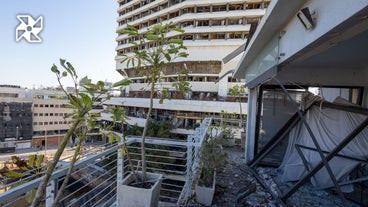
Iranian missile strike on Soroka Medical Center in southern Israel causes extensive damage and injuries. Footage shows blown-out windows and heavy smoke following the attack, which also targeted residential buildings near Tel Aviv. At least 40 people wounded. Israel retaliates with strikes on Iran's Arak nuclear reactor
Multiple missile attacks near Tel Aviv and southern Israel caused significant damage and injuries. At least 40 people were wounded in strikes targeting residential buildings and the Soroka Medical Center, a major hospital. The attacks follow ongoing conflict and retaliatory strikes between Israel and Iran
Israel's ongoing conflict with Iran intensifies as Israeli airstrikes target Iran's Arak heavy water reactor on day seven. This latest attack on Iran's nuclear program follows a surprise wave of Israeli strikes targeting military sites, senior officers, and nuclear scientists. The conflict began with a barrage of Iranian missiles and drones, many intercepted by Israeli air defenses
Israel's multi-tiered air defense system intercepted hundreds of Iranian missiles and drones launched at civilian population centers and critical infrastructure. While most attacks were thwarted, Israeli officials acknowledge the system's limitations following recent strikes, including a missile impacting a major hospital
Iranian missile strike damages Soroka Medical Center, Israel's major southern hospital (1,000+ beds), serving over 1 million residents. The attack caused extensive damage and injuries, forcing the hospital to close to all but emergency cases
Soroka Medical Center in Southern Israel, a 1,000+ bed hospital, sustained significant damage from an Iranian missile strike. The emergency room treated minor injuries, but the hospital temporarily closed to all but life-threatening cases following the attack. While the exact number of wounded remains unclear, the incident highlights the escalating conflict and the impact on civilian infrastructure
Following Iranian missile attacks, Israeli hospitals implemented emergency protocols. Underground parking facilities were converted into makeshift hospital wards to relocate vulnerable patients, particularly those on ventilators or requiring rapid evacuation, ensuring continued critical care amidst the ongoing conflict
Israeli airstrikes target Iran's Arak nuclear reactor, aiming to disable its plutonium production capabilities by striking the reactor core seal. This action follows a week of intense conflict, including Iranian missile attacks on Israeli hospitals and civilian infrastructure
Israel's military launched airstrikes against Iran's Arak heavy water reactor, disabling its plutonium production capabilities and hindering its nuclear weapons program. A separate strike targeted another Natanz facility linked to Iran's nuclear ambitions. This action follows days of escalating conflict and Iranian missile attacks on Israel
Following Israeli airstrikes on Iran's Arak heavy water reactor, Iranian state television reported no radiation leak or damage to nearby civilian areas, stating the facility was evacuated
Israel launched preemptive strikes on Iranian facilities after issuing public warnings and urging evacuations. Following Iranian missile attacks on a major hospital in southern Israel and other residential buildings near Tel Aviv, injuring at least 40, Israel retaliated against Iran's Arak heavy water reactor, aiming to disrupt its nuclear program
Iran's uranium enrichment program, reaching 60%, nears weapons-grade levels (90%), raising international concerns. This high enrichment level is unprecedented for a non-nuclear weapons state, fueling tensions amidst ongoing conflict
Israel's undeclared nuclear arsenal: A Middle Eastern power in a state of conflict. Amidst Iranian missile attacks on Israeli hospitals and infrastructure, including the Soroka Medical Center in southern Israel, the nation's ambiguous nuclear weapons policy remains a key geopolitical factor
Iranian missile strikes hit Israel, causing significant damage to a major hospital and residential buildings near Tel Aviv. Following Iran's rejection of US calls for surrender and threats of retaliation, the attacks injured at least 40 people. Israel responded with strikes on Iran's Arak heavy water reactor, escalating the ongoing conflict. This latest escalation follows days of Iranian missile and drone attacks, and Israeli countermeasures
Israel's retaliatory strikes against Iran's nuclear program have targeted key facilities, including the Natanz enrichment site, centrifuge workshops near Tehran, and the Isfahan nuclear site. These operations, part of an ongoing conflict, also included the elimination of high-ranking Iranian military officials and nuclear scientists
A Washington-based Iranian human rights group said at least 639 people, including 263 civilians, have been killed in Iran and more than 1,300 wounded. In retaliation, Iran has fired some 400 missiles and hundreds of drones, killing at least 24 people in Israel and wounding hundreds.
The Arak heavy water reactor is 250 kilometers (155 miles) southwest of Tehran.
Heavy water helps cool nuclear reactors, but it produces plutonium as a byproduct that can potentially be used in nuclear weapons. That would provide Iran another path to the bomb beyond enriched uranium, should it choose to pursue the weapon.
Iran had agreed under its 2015 nuclear deal with world powers to redesign the facility to relieve proliferation concerns.
In 2019, Iran started up the heavy water reactor’s secondary circuit, which at the time did not violate Tehran’s 2015 nuclear deal with world powers.
Britain at the time was helping Iran redesign the Arak reactor to limit the amount of plutonium it produces, stepping in for the U.S., which had withdrawn from the project after President Donald Trump’s decision in 2018 to unilaterally withdraw America from the nuclear deal.
The International Atomic Energy Agency, the United Nations’ nuclear watchdog, has been urging Israel not to strike Iranian nuclear sites. IAEA inspectors reportedly last visited Arak on May 14.
Due to restrictions Iran imposed on inspectors, the IAEA has said it lost “continuity of knowledge” about Iran’s heavy water production ― meaning it could not absolutely verify Tehran’s production and stockpile.
As part of negotiations around the 2015 deal, Iran agreed to sell off its heavy water to the West to remain in compliance with the accord’s terms. Even the U.S. purchased some 32 tons of heavy water for over $8 million in one deal. That was one issue that drew criticism from opponents to the deal.
___
The headline of this story has been corrected to show that 40 people were wounded in several strikes, not the one on the hospital.
___
Gambrell reported from Dubai, United Arab Emirates.
Source: Original Article