
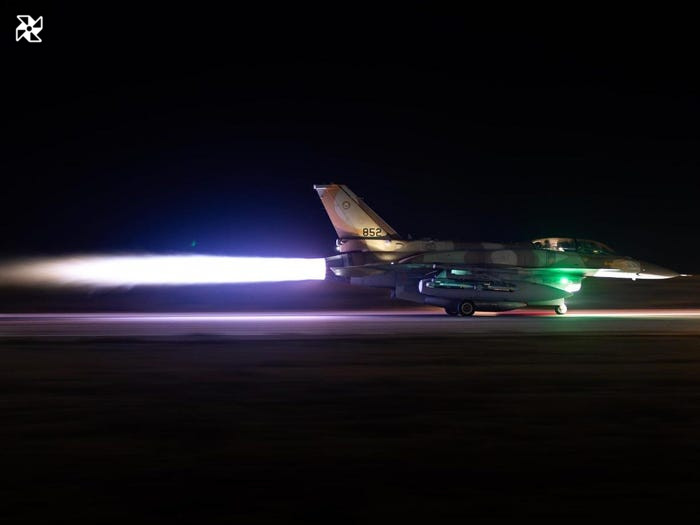
Israel's extensive airstrikes on Iranian nuclear and ballistic missile facilities achieved a key objective, significantly damaging the programs. Over 100 targets, including air defense systems, missile launchers, and military leadership, were struck. Iran's response, involving drone and missile attacks, raises concerns of wider conflict and potential US involvement. The impact of these strikes and Tehran's retaliation are analyzed, exploring the escalating tensions in the Middle East
Israel's Devastating Airstrikes on Iran: Over 100 Military Targets Hit
Israel launched widespread airstrikes targeting over 100 Iranian military sites, including air defense systems, missile launchers, and senior military leadership. The strikes significantly damaged Iran's nuclear and ballistic missile programs, prompting a response from Tehran and raising concerns of wider conflict and potential US involvement
Iran's response to Israel's extensive airstrikes is imminent, raising concerns of wider Middle East conflict and potential US involvement. Will Tehran retaliate? What form will this response take? The possibility of escalating tensions and a broader war demands close attention
Key Questions Following Israel's Airstrikes on Iran: Tehran's Response & Potential Escalation
Iran's Retaliation: 100 Drone Attack on Israel After Airstrikes. Following widespread Israeli airstrikes targeting Iranian nuclear and missile facilities, Iran launched a retaliatory attack involving approximately 100 drones. The Israel Defense Forces (IDF) reported that most of these drones were successfully intercepted. This response, along with subsequent missile launches, raises concerns about further escalation and potential US involvement in the conflict
Iran vows severe retaliation against Israel following widespread airstrikes targeting Iranian nuclear and ballistic missile facilities. Supreme Leader Ayatollah Ali Khamenei promises punishment for the attacks, escalating tensions in the Middle East and raising concerns of wider conflict. Tehran's initial response involved drone and missile attacks, prompting questions about the timing and scale of further retaliation
Following Israel's extensive airstrikes on Iranian military and nuclear facilities, Iran retaliated with a multi-wave missile barrage against Israel. Dozens of missiles were launched, prompting a robust response from Israel's air defenses, which intercepted many of the incoming projectiles. Video evidence confirmed multiple missile impacts
Iran's response to Israel's airstrikes may be delayed or phased, according to Matthew Savill, Director of Military Sciences at the Royal United Services Institute (RUSI). While ballistic missiles, offering the best chance of inflicting damage, are expected to be a key component of Tehran's retaliation, drone and cruise missile attacks will likely face stronger Israeli defenses
Iran's retaliation for Israeli airstrikes will likely center on ballistic missiles, offering the highest probability of impacting Israel. Drone and cruise missile attacks, however, face significantly stronger Israeli defenses
Iran's missile attacks on Israel: A history of retaliation. Previous Iranian missile and drone strikes, including hundreds launched in April and October 2023, were largely intercepted by Israeli and US defenses. This context is crucial as Tehran vows retaliation for recent Israeli airstrikes
Iran's potential retaliation for Israeli airstrikes extends beyond direct attacks. Tehran could leverage its regional allies, the so-called "Axis of Resistance," a network encompassing groups like Hezbollah in Lebanon and the Houthis in Yemen, for proxy attacks and further conflict escalation
Israel has been battling these forces, and Hamas in Gaza, since the October 7, 2023, attacks.
Israel's Prime Minister Benjamin Netanyahu's longstanding call to dismantle Iran's nuclear program, which Iran maintains is for peaceful purposes, has taken center stage following widespread Israeli airstrikes targeting Iranian nuclear and ballistic missile facilities
Israel's recent airstrikes on Iran's nuclear and military sites risk derailing ongoing US-Iran nuclear negotiations. The attacks, targeting Iranian air defenses, missile launchers, and leadership, could provoke a retaliatory escalation, potentially pushing Iran towards accelerated nuclear weapons development and increasing the risk of wider conflict, even US involvement
Israel's airstrikes on Iran risk escalating regional conflict, warns Chatham House. The extensive attacks targeting Iranian nuclear and missile facilities sparked immediate retaliation and raise concerns of wider Middle East war and potential US involvement
“Far from being a preventive action, this strike risks triggering a broader regional escalation and may inadvertently bolster the Islamic Republic’s domestic and international legitimacy,” Sanam Vakil, Chatham House’s Middle East and North Africa program director, said.
Last year, Tehran reportedly threatened to target Gulf state oil facilities if they allowed Israel access to their airspace for strikes against Iran. It’s unclear what routes Israeli aircraft used in the attacks, but there’s been speculation Israel could exploit the collapse of the Assad regime in Syria to get its aircraft directly over Iraq for strikes.
Russia is also a close ally of Iran, and the two have increased their defense cooperation since Russia launched its full-scale invasion of Ukraine in 2022.
However, Nikita Smagin, an analyst at the Carnegie Endowment, said in December that the Kremlin is unlikely to come to Iran’s direct aid in order to avoid direct confrontations with Israel and the US.
The US has helped arm and defend Israel, notably in the wake of Hamas’ October 7 attacks. The world will be watching to see how President Donald Trump responds.
Trump has sought to broker a new nuclear deal with Iran, and in the wake of the Israeli attacks overnight, warned of “even more brutal” strikes from Israel if Iran refuses a new agreement.
Last year, the US Navy helped shoot down Iranian missiles fired at Israel in two major attacks, and it has rotated multiple aircraft carriers and many warships into the region since 2023, in a show of support for Israel and to deter its enemies, including Iran.
The US and other NATO countries have also defended international shipping routes in the Red Sea and the Gulf of Aden from attacks by the Iran-backed Houthi militants in Yemen.
The US has a substantial military presence in the Middle East, including naval forces, ground troops, and strike aircraft.
A Navy spokesperson told BI that the Carl Vinson Carrier Strike Group — consisting of an aircraft carrier, a cruiser, and three destroyers — is in the Arabian Sea.
There are also three American destroyers in the Red Sea and another in the Eastern Mediterranean.
All of these warships, and the carrier’s dozens of embarked aircraft, are capable of carrying out air defense missions to defeat incoming drones and missiles.
IDF spokesperson Brig. Gen. Effie Defrin said Israel’s strikes “significantly harmed” Iran’s main uranium enrichment site at Natanz.
“For many years, the people of the Iranian regime made an effort to obtain nuclear arms in this facility,” he said, adding that the site “has the necessary infrastructure to enrich uranium to a military grade.”
The International Atomic Energy Agency has confirmed the site was struck, but the extent of the damage remains unverified.
Satellite imagery appeared to show significant damage at the surface level.
There was also a report Friday that Israel had struck Fordow, a nuclear fuel enrichment site guarded deep under a mountain.
Overnight, Israeli strikes reportedly targeted strategic Iranian sites, including the Natanz nuclear facility, Iran’s primary center for uranium enrichment. High-resolution imagery from @AirbusDefence, captured on June 13, 2025, reveals significant damage to the facility. pic.twitter.com/L7y9V64NIq
The IDF said that Iran’s Islamic Revolutionary Guard Corps chief Hossein Salami and other senior military commanders were also killed in targeted strikes.
Source: Original Article